
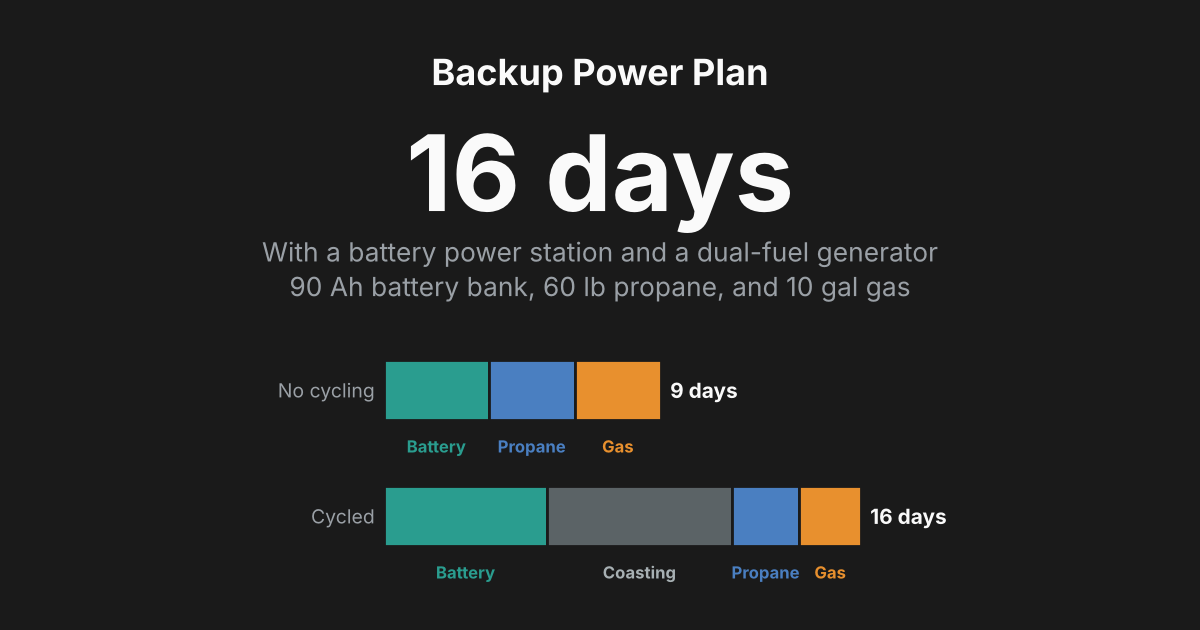
If you’d like to get into details for your backup power plan, check out this playbook I developed. It details the daily timeline for generator and battery charging cycles, how many days are covered, and on which fuel or power supply.
For this example house, at an average 30°F outside, I’ve got a plan that covers about 16 days with a dual-fuel generator, propane, gas, and a 90Ah set of batteries (and our natural gas supply).
Keep vitals running
For the purposes of this plan, I’m not aiming to power the whole house and all of its non-essentials. Mainly, I want to run a scenario plan to keep vitals running. Heat in winter: the house furnace, and garage boiler optional if I want to keep it above freezing. Food preservation with fridge and freezer - easier in winter, assuming it’s fridge to freezer temps outside. But making a plan here to generally cover both should put me in a safe position to cover what’s needed in worst-likely-case weather scenario. Also figuring a bit of buffer for light household item use (is the coffee grinder essential? …can grind manually in a pinch;). Both the furnace and the garage boiler burn utility natural gas, so our electrical backup solution only needs to power their controls, fans, and pumps.
I’m not going to cover this in detail here, but to connect the backup solution, we’ll need to work out wiring to plug in the furnace (I can work that out on the fly if needed, or I’ll get it done in advance… If you’d need to get an electrician involved, then obviously plan ahead and get it done in advance so your plan is ready to run when it’s needed:).
The water heater is also run on natural gas, but it runs independent from the electrical grid. Fun fact, the tiny voltage that runs the water heater controller comes from a thermopile powered by the pilot flame, so only the natural gas supply is needed to keep that online. (Note, if your water heater runs on electricity, you’ll also have to consider your backup needs and options on that front!)
Backup power supplies
- A ~3,900W dual-fuel inverter generator
- Ridgid batteries, about 90 Ah, run through a Ryobi power station
- 60 lb of propane in three 20 lb tanks (figuring 54 lb actual, with loss buffer)
- 10 gallons of gas in two 5 gal jerry cans
Vehicle fuel tanks can be used as reserve, but not included here.
Cycling strategy to extend coverage
A generator burns nearly the same fuel whether the electrical draw is small or large. There’s cost in just keeping the engine running, regardless of power draw. So the cycling plan aims to concentrate output draw with longer heating cycles, capturing energy in battery charging at the same time, allowing for shorter sprints and shutting off the generator in between.
During a generator sprint cycle, everything that needs power runs at once: the house furnace and garage boiler run with the thermostats turned up, the fridge and freezer run to pull down their temps again, and the batteries charge. Then during the generator off cycle, we let those temperature levels coast for a bit. Or run selective small loads from the batteries with the power station instead of firing up the generator.
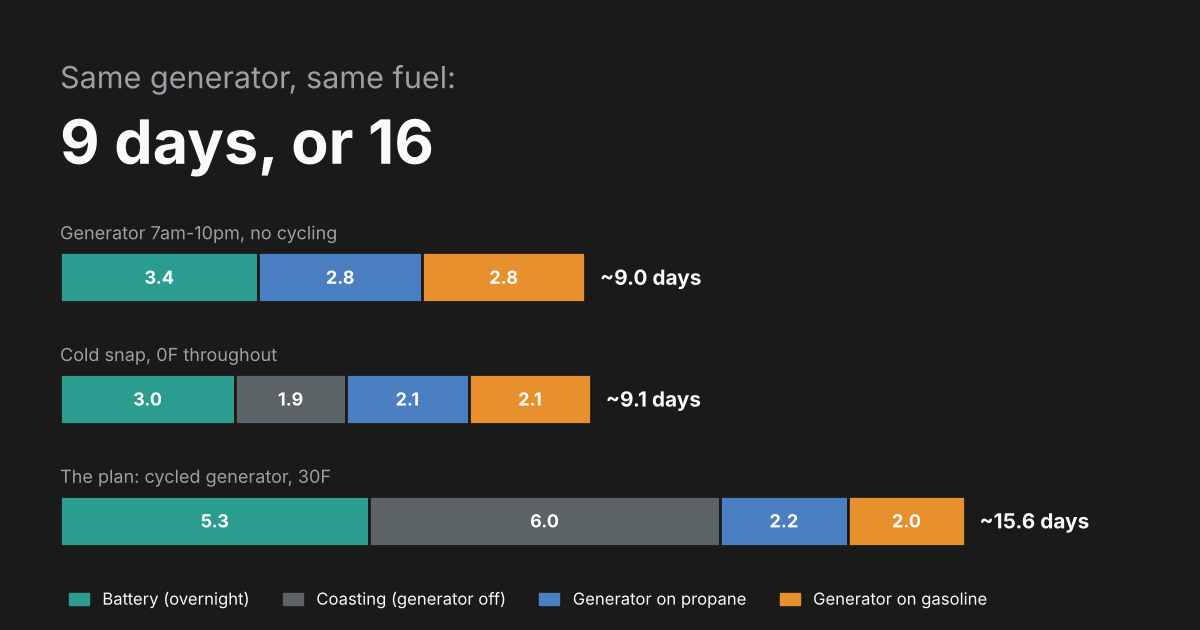
Running the same generator straight from 6am to 10pm with no cycling covers about 9 days. With the cycling strategy we can project coverage to something more like 15+ days!
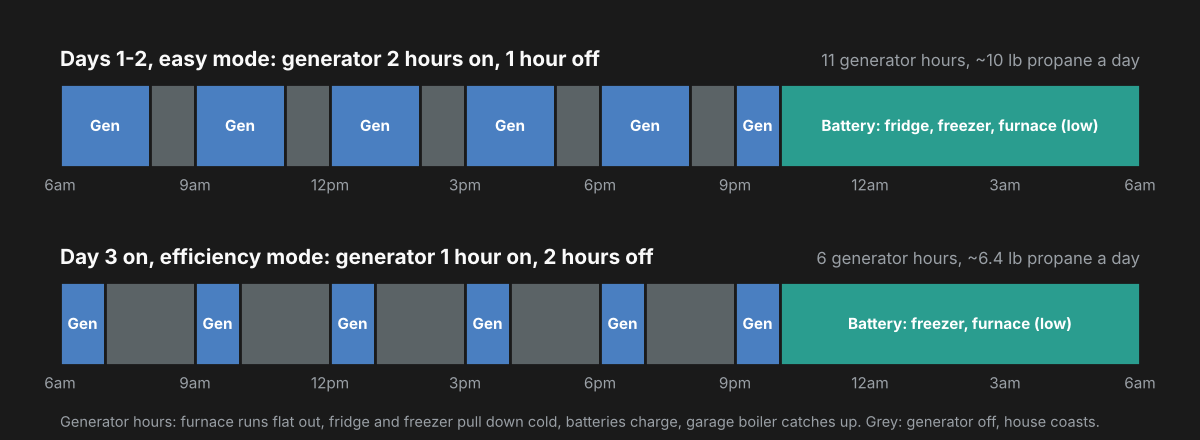
Days 1-2: easy mode
- This covers a short 1-2 day outage with relatively easy setup and operation
- If an outage were to last longer, this gives us a couple days to adjust and get used to living with backup power, work out food routine and plans, etc.
- Generator on 2 hours, off 1 hour, from 6am to 10pm
- Battery overnight, 10pm to 6am: fridge, freezer, and the furnace on a low thermostat
- One battery pack swap around 2:30am
- About 11 generator hours and 10 lb of propane a day
Day 3: start efficiency mode
On day 3 you could tighten the plan:
- This model triggers efficiency mode on day 3.
- This is an adjusted mode we can audible into if we feel like projected fuel supply on easy mode might be outrun by length of the outage.
- You’ll obviously assess whatever threshold you see fit based on the actual situation on the ground, projections, and circumstances of your home and the outage.
- You’ll be weighing some work and discomfort against your urgency prospects.
- At this point after a couple days of outage, you’ll have some information to assess the outage length, or how difficult it may be to restock on fuel.
- Main efficiency mode changes:
- The big freezer moves from the basement out to the garage, which is holding 35-38°F anyway. That cuts its work by about 45%.
- The fridge can get unplugged - remaining food could move to coolers in the cold garage, or use outdoor temps to freeze stuff and keep the fridge cooled like an icebox.
- The generator cycle can probably drop closer to 1 hour on, 2 hours off, and the daytime thermostat set a little lower.
- No more overnight battery swaps are needed in this mode. With the fridge off, a fully armed battery power station has about 0.5 kWh to spare overnight - roughly an hour of furnace run-time buffer.
- Consumes about 6.4 lb of propane for 6 generator hours per day
Timeline (30°F scenario)
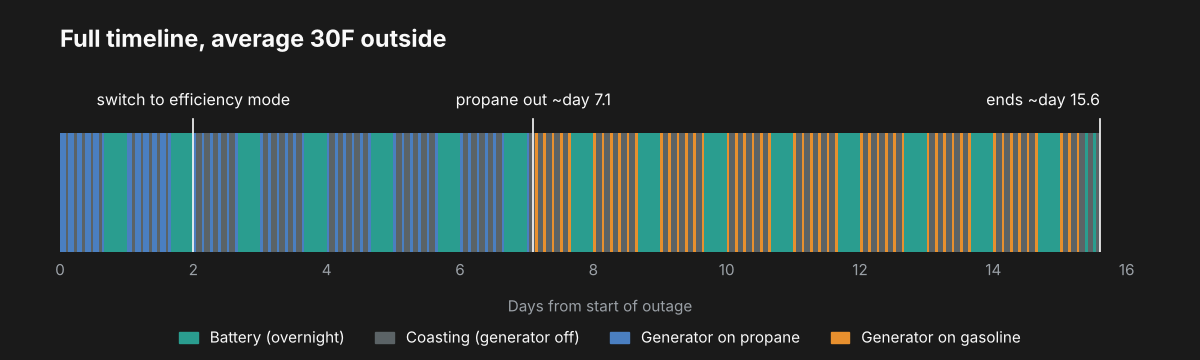
- Propane lasts to about day 7.1
- Gasoline extends range to about day 15.3
- The last bit of battery capacity would finish off at 15.6 days
- Across those days the generator is only running about a quarter of the time. The rest is covered with banked battery power or coasting time.
Cold weather (0°F scenario)
Figuring for something like an average 0°F cold snap, the furnace would have to run about two-thirds of the day, so we keep the 2 hrs on/1 hr off cycle the whole way through. In this scenario, our run-time coverage drops to about 9.1 days. Cold nights may need more furnace time even if we buffer it by setting the thermostat lower.
Cold 20 lb tanks can also deliver propane more slowly. Manifolding two tanks together, keeping them sheltered, or switching over to gasoline are potential workarounds.
If you’re shopping generators, note there are models available with remote control fobs. It could be a nice convenience upgrade to consider if you’ll be living with this plan cycling on/off multiple times through each day of an outage (or for your other more common use cases for a generator).
Calculation assumptions
These are rough, plus or minus 30%:
- Daily generator output at 30°F about 7.6 kWh on days 1-2 and 5.8 kWh from day 3; at 0°F about 10-11 kWh
- Furnace about 600W while firing; garage boiler about 20W average at 30°F, 60W at 0°F
- Propane burn about 0.5 lb/hr plus 0.6 lb per kWh; 1 lb propane is about 0.19 gal of gas
- 18 lb usable per 20 lb tank
- Battery about 1,250-1,300 Wh usable
Overview reference page
Your solution will be different, of course, but the method is transferable. Collect equipment specs and run calculations for your furnace and appliances, consider your fuel and power supply options, and tailor the plan for your household needs. List what has to run, decide what’s vital or most likely to be running in your primary plan, calculate what your generator burns, build the timeline with cycling for efficiency, then project how many days of coverage you’ve got.
If you would like help building a plan like this for your own home, it’s one of many things we can do for you with Bedrock & Bloom consulting services.